How to handle duplicate element locators?

Have you come across use cases when you have create multiple element locators for almost similar element locators?
Consider following text box, which gets date filled when user clicks on - expired, today, end of week etc links -


Screenshot from 2016-04-30 21:49:18.png


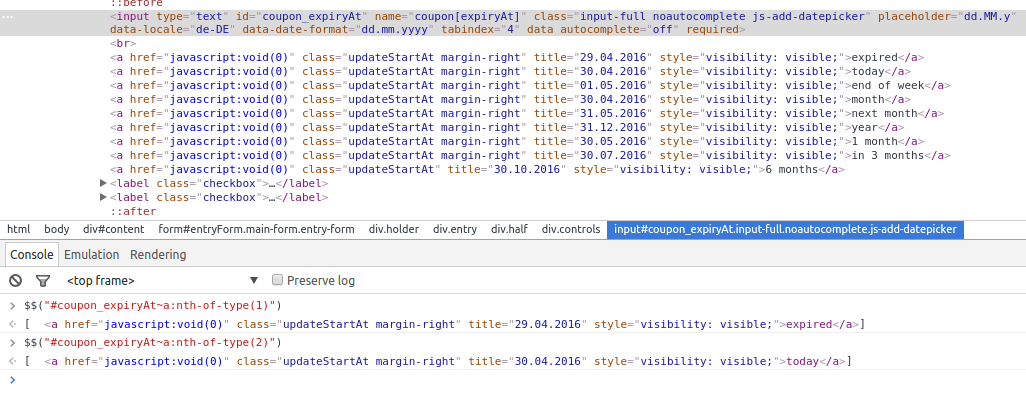
This is how page html looks -


Screenshot from 2016-04-30 21:56:44.png


And the element locators for expired, today etc link could be -


"#coupon_expiryAt~a:nth-of-type(1)"
"#coupon_expiryAt~a:nth-of-type(2)"


There are other possible element locators but each link requires its own element locator.
Now considering earlier example, the only difference in element locator is index number 1, 2 etc


So what if we could get rid of creating different element locators and pass index number depending on the link we want to interact with?


Let’s create base element locator -


private static LinkElement getExpiryLinkElement(int index) {
  return new LinkElement("Expired Link",
          By.cssSelector(String.format("#coupon_expiryAt~a:nth-of-type(%s)", index)));
}


Let’s set up an enum for expired, today etc links -


public enum ExpiryDate {
  EXPIRED, TODAY, END_OF_WEEK, MONTH, NEXT_MONTH, YEAR, ONE_MONTH, THREE_MONTH, SIX_MONTH;
}


And a method which returns element locator corresponding to expired, today etc links


private LinkElement getExpiryLink(ExpiryDate expiryDate) throws Exception {


  switch (expiryDate) {


  case EXPIRED:
      return getExpiryLinkElement(1);


  case TODAY:
      return getExpiryLinkElement(2);


  case END_OF_WEEK:
      return getExpiryLinkElement(3);


  case MONTH:
      return getExpiryLinkElement(4);


  case NEXT_MONTH:
      return getExpiryLinkElement(5);


  case YEAR:
      return getExpiryLinkElement(6);


  case ONE_MONTH:
      return getExpiryLinkElement(7);


  case THREE_MONTH:
      return getExpiryLinkElement(8);


  case SIX_MONTH:
      return getExpiryLinkElement(9);
  }


  throw new Exception("Invalid expired Link");


}


Method to select expiry date would be -

public PageObject selectExpiryDate(ExpiryDate expiryDate) throws Exception {
   getExpiryLink(expiryDate).click();
  return this;
}


Now test method could set any of the expiry date as -


selectExpiryDate(ExpiryDate.EXPIRED)
Or


selectExpiryDate(ExpiryDate.TODAY)


and so on...

What do you think of this approach which gets us rid of creating 9 element locators? How would you have approached it?

Popular posts from this blog

Using xPath to reach parent of an element

Note: If you are new to java and selenium then start with selenium java training videos .   I prefer css locator over xPath but there are times when css locators don't fit requirement. One such requirement is when you want to navigate to parent element of an element and may be parent of parent and even more. Unfortunately css locators don't provide any mechanism to navigate to parent of an element. See this for more. Of late I came across a scenario when I wanted to click on a link depending upon the text in a text box. Herein parent of text box and parent of link were at the same location. More over there could have been many such combinations in application. Fortunately I just need to pick first such instance and Web Driver any way considers only first instance when multiple locators are found matching an element. Element in question is in following html - Here I need to click on highlighted anchor on the basis of input element (which is also hig...

Selenium Tutorial: Ant Build for Selenium Java project

Ant is a build tool which could be used to have your tests running either from command line or from Hudson CI tool. There is detailed documentation available for ant here but probably you need to know only a little part of it for you selenium tests. The essentials which are needed to know are: Project Target (ant execution point and collection of tasks) Tasks (could be as simple as compilation) And there would usually be following targets for Selenium tools - setClassPath - so that ant knows where you jar files are loadTestNG - so that you could use testng task in ant and use it to execute testng tests from ant init - created the build file clean - delete the build file compile - compiles the selenium tests run - executes the selenium tests Here is my project set up for ant -

Should selenium tests be always independent? The endless debate !!

Though unit tests have always recommended to be independent of each other, advent of selenium+TestNG has given birth to dependent integration/end to end tests. TestNG Author Cédric Beust had written about it few years ago. When I had begun writing selenium tests I used to launch browser once in one test class and test methods were usually dependent on one another. Hence 2nd test method would begin test run on same browser + application state where 1st test method stopped. Launching just one browser for five or more test methods in a class is big time saving is not it? Well not really, for the reasons I am going to describe in this post. Since then I have moved on to launching browser per test method but yet give in “charm” of dependent test methods at times. to So here are the few pros and cons for dependent tests and - Pros - Similar steps of execution don’t have to be repeated in multiple tests when steps constitutes a test method in themselves If login fails then...